

An AI marketing tool should solve a clear campaign task, such as research, writing, design or publishing. Short answer: ChatGPT is the best AI marketing tool for most teams because it can move from customer research and campaign strategy to copy, analysis, images, and reusable workflows in one flexible workspace. Jasper is better for governed, on-brand campaign production; HubSpot Breeze is the best choice when customer data and automation already live in a CRM; Canva is the fastest route from an idea to publishable social creative; Writesonic is our pick for SEO and AI-search visibility; and Zapier is the best tool for connecting the whole marketing stack.
How to use this guide
There is no single “AI marketing” job. A growth lead analyzing win-loss interviews, a content team planning an answer-engine strategy, a designer producing 30 campaign variants, and an operations manager routing leads are solving different problems. The right purchase is therefore not the tool with the longest feature list. It is the tool that removes the most expensive bottleneck in your current workflow.
This guide compares 15 products across strategy, copy, customer relationship management, design, SEO and generative engine optimization, social publishing, editing, video, voice, localization, and automation. Specifically, we reviewed current product interfaces, official documentation, plan pages, workflow controls, integrations, and the job each platform is designed to finish. Product information and prices were verified on August 25, 2026.
AI products and prices change quickly. A plan may also differ by country, billing cycle, contact count, seat count, credits, model, or add-on. Confirm the live plan, privacy terms, usage rights, and limits before putting customer data or a paid campaign into any platform.
Best AI marketing tools: the winners at a glance
- Best overall: ChatGPT. The most versatile workspace for research, strategy, messaging, analysis, asset creation, and repeatable campaign workflows.
- Best for on-brand campaign production: Jasper. Purpose-built brand voices, audiences, knowledge, marketing agents, and governance for teams that publish at scale.
- Best for go-to-market workflows: Copy.ai. Strong when a team wants to codify repeatable research, account, content, and sales-marketing processes.
- Best CRM-centered platform: HubSpot Breeze. AI grounded in the contacts, lifecycle history, content, campaigns, and reporting already inside HubSpot.
- Best for everyday campaign design: Canva AI. The quickest way for non-designers and social teams to create, resize, translate, schedule, and govern visual content.
- Best for production-grade campaign visuals: Adobe Firefly. A creative AI studio that fits naturally beside Photoshop, Express, Premiere, and enterprise Adobe workflows.
- Best for SEO and AI visibility: Writesonic. Combines content production, site auditing, brand tracking in answer engines, and action-oriented optimization.
- Best for optimizing an important page: Surfer. Clear content guidance, page auditing, topical research, and AI-search monitoring for hands-on SEO teams.
- Best content operating system: Frase. Research, drafting, audits, decay monitoring, publishing, and AI-visibility features in one structured loop.
- Best final editorial layer: Grammarly. Fast, consistent revision across the browser, documents, email, and team workflows.
- Best social publishing assistant: Buffer. Affordable planning, repurposing, scheduling, analytics, and community work without enterprise complexity.
- Best for localized marketing video: HeyGen. Digital presenters, custom avatars, translation, voice cloning, and lip-sync localization.
- Best for structured business video: Synthesia. Repeatable presenter-led explainers, product education, enablement, and governed team production.
- Best for voice and dubbing: ElevenLabs. High-quality voiceovers, multilingual dubbing, sound effects, music, and audio production.
- Best for marketing automation: Zapier. Connects forms, CRMs, spreadsheets, email platforms, databases, and AI steps into working systems.
Related guides for your marketing workflow
If your primary deliverable is visual, compare our guides to the best AI image generators and best AI video generators. For a general assistant decision, see ChatGPT vs Claude vs Gemini and our guide to the best ChatGPT alternatives.
The 15 best AI marketing tools compared
| Tool | Best for | Free entry | Paid entry | Main trade-off |
|---|---|---|---|---|
| ChatGPT | Overall marketing work | Yes | Plus $20/mo | Needs a strong brief and factual review |
| Jasper | On-brand campaign production | 7-day trial | Pro $69/mo monthly | Expensive for a solo general-purpose user |
| Copy.ai | Go-to-market workflows | Limited entry | Chat $29/mo | Workflow value requires setup discipline |
| HubSpot Breeze | CRM-centered marketing | Yes | Marketing Hub Starter from $20/seat/mo | Professional automation becomes expensive |
| Canva AI | Social and campaign design | Yes | Pro $144/year | Template-driven work can look generic |
| Adobe Firefly | Commercial creative production | Limited daily generations | Standard $9.99/mo | Premium models can consume credits quickly |
| Writesonic | SEO and AI-search visibility | Trial | Starter $79/mo annually | Pricing is high for basic writing alone |
| Surfer | On-page optimization | Trial | Discovery $49/mo annually | Scores can encourage over-optimization |
| Frase | Content operations | 7-day trial | Starter $39/mo annually | AI drafts still need expert editing |
| Grammarly | Editing and consistency | Yes | Pro $12/mo annually | Not a campaign planning platform |
| Buffer | Social publishing | Up to 3 channels | Essentials $5/channel/mo annually | Limited for complex paid-social operations |
| HeyGen | Localized marketing video | 3 videos/mo | Creator $29/mo | Premium generations use credits quickly |
| Synthesia | Structured business video | Basic plan | Starter $29/mo | Less natural for cinematic brand work |
| ElevenLabs | Voiceovers and dubbing | 10k credits/mo | Starter $6/mo | Shared credits complicate cost forecasts |
| Zapier | Marketing automation | 100 tasks/mo | Professional from $19.99/mo | Task costs grow with multi-step volume |
Prices are starting US prices before tax. In addition, Annual discounts, temporary promotions, usage credits, contacts, seats, and add-ons can change the effective cost. The table is a buying shortcut, not a substitute for checking whether the included limits cover your real monthly volume.
How we evaluated AI marketing tools
Specifically, we mapped the tools against one practical launch cycle: synthesize customer evidence, define positioning, write a campaign brief, produce channel assets, optimize discoverability, publish, route responses, localize high-performing content, and turn results into the next decision. A product earned a place only if it could own a meaningful stage of that cycle—not simply add a chat box to existing software.
We compared each platform using seven criteria:
- Strategic usefulness: whether the tool helps a marketer understand evidence and make a decision, not only generate more words.
- Brand control: support for voice, style, approved knowledge, audiences, templates, permissions, review, and consistency across channels.
- Workflow depth: the path from input to publishable output, including research, collaboration, revision, export, scheduling, or automation.
- Channel fit: how well the product handles the channel it claims to serve—search, email, social, design, video, audio, CRM, or operations.
- Measurement and iteration: whether outputs connect to performance signals, customer data, audits, analytics, or a repeatable feedback loop.
- Value: usable free access, starting price, seats, contacts, credits, task limits, integrations, and hidden scaling costs.
- Operational readiness: privacy, governance, consent, licensing, human review, and the ability to use the product responsibly with real customer work.
These rankings are independent workflow recommendations based on current product design, documentation, interfaces, and pricing. However, they are not sponsored, and “best” does not mean a product should replace human research, positioning, taste, legal review, or final approval.
1. ChatGPT: best AI marketing tool overall
 ChatGPTBest overall AI marketing workspaceView tool details →
ChatGPT wins overall because it can follow a campaign from ambiguity to execution. For example, a marketer can upload interview notes, sales calls, research, a product brief, previous creative, and performance data; ask for patterns and open questions; build positioning; explore concepts; draft assets; create images; analyze a spreadsheet; and preserve the work inside a project or reusable GPT.
OpenAI’s current marketing guidance focuses on that connected workflow: customer understanding, strategy, creative development, execution, and performance analysis. This breadth makes ChatGPT more useful than a specialist when a small team needs one flexible starting point.
Where ChatGPT is strongest
Research and synthesis. Deep research, web search, file analysis, and structured reasoning help turn scattered evidence into a useful brief. Multimodal creation. Furthermore, the same conversation can produce copy, concepts, tables, images, and analysis. Reusable context. Also, Projects and custom GPTs make it possible to encode an approved brand brief, product facts, output format, and review checklist.
Where ChatGPT falls short
However, it is only as grounded as the material and instructions you provide. Even so, Confident claims, invented customer quotes, weak differentiation, and generic brand language remain possible. It also lacks the native campaign calendar, contact model, publishing controls, and attribution of a dedicated marketing platform. Therefore, keep source evidence attached, require citations for research, and separate ideation from approval.
ChatGPT has a free plan. Plus costs $20 per month; business plans add shared workspaces and organizational controls. Choose ChatGPT if: you want the most adaptable marketing thinking and production partner before investing in several specialists.
2. Jasper: AI marketing tool for on-brand campaign production

 JasperBest on-brand campaign productionView tool details →
Jasper is the strongest recommendation for a marketing department whose real problem is not generating a first draft, but generating hundreds of assets that still reflect the same brand. Jasper IQ organizes Brand Voices, audiences, knowledge, style guidance, and marketing best practices so teams can reuse approved context instead of rebuilding it in every prompt.
Specifically, the platform combines a marketing editor, Canvas, collaboration, agents, content remixing, image tools, browser extensions, and enterprise governance. Business customers can build no-code custom agents and systematic workflows, while Jasper Grid supports higher-volume execution.
Where Jasper is strongest
Brand governance. For instance, voice, audience, company knowledge, permissions, and style rules are first-class product objects. Marketing specialization. More than 100 purpose-built agents and workflows cover common campaign jobs. Scale. Collaboration, APIs, integrations, controls, and usage reporting make sense for a department rather than one copywriter.
Where Jasper falls short
Even so, a solo marketer may get broader value from ChatGPT at a lower price. Jasper also cannot repair weak positioning: if the uploaded knowledge is vague, the platform can produce consistent but forgettable content. Nevertheless, advanced GEO, Grid, API, and agent actions may introduce credits or business-tier costs.
Jasper Pro costs $69 per month monthly or $59 per month when billed yearly, with one seat; Business pricing is custom. Choose Jasper if: several marketers or agencies must create large volumes without losing brand control.
3. Copy.ai: AI marketing tool for go-to-market workflows

 Copy.aiBest go-to-market workflow builderView tool details →
Copy.ai has moved beyond the original promise of fast ad copy. Specifically, its more useful identity is a go-to-market platform where a team can combine chat with multi-step workflows for account research, prospecting, content production, localization, sales enablement, and other repeatable processes.
For example, a workflow stitches AI actions together around an input and an expected output. That matters when the job is not “write an email,” but “collect account facts, identify a relevant trigger, match the account to an approved value proposition, produce a draft, and save the result in the next system.”
Where Copy.ai is strongest
Process codification. As a result, it turns a good internal method into a reusable workflow. Model choice. Chat provides access to models from multiple providers. Revenue-team alignment. Marketing and sales can share research, messaging, and account processes instead of building disconnected prompt libraries.
Where Copy.ai falls short
That said, the return depends on process design, data quality, integration work, and ownership. A badly defined workflow simply automates inconsistent thinking. Credit-heavy plans are also aimed at teams with enough recurring volume to justify implementation.
The self-serve Chat plan costs $29 per month or $24 per month annually for five seats. Workflow plans scale sharply from there. Choose Copy.ai if: your team wants to standardize recurring go-to-market work rather than buy another isolated writing assistant.
4. HubSpot Breeze: AI marketing tool for CRM-centered marketing

 HubSpot BreezeBest CRM-centered AI marketing platformView tool details →
For teams with customer data in a CRM, HubSpot is the best option when AI should act on customer context rather than sit beside it. Breeze Assistant and embedded AI features work inside the Smart CRM, while agents and Marketing Hub features can support content, campaigns, search visibility, lead management, email, automation, and reporting.
The central advantage is continuity. For instance, a campaign can use the same contact properties, lifecycle stages, forms, website activity, campaign assets, and reporting that the team already trusts. HubSpot’s AEO features also track how a brand appears in answer engines and connect recommendations to the broader content operation.
Where HubSpot is strongest
Customer data. AI can work with live CRM and campaign context. Closed-loop operations. In addition, forms, email, workflows, sales handoff, service, and reporting live in one system. Adoption. More than 100 embedded AI features are available even before a company buys a specialist agent platform.
Where HubSpot falls short
On the other hand, professional automation and reporting are expensive, and contact tiers, seats, credits, onboarding, and add-ons can make the real price difficult to model. A messy CRM also produces messy personalization. Clean lifecycle definitions and permission rules before adding more automation.
HubSpot offers free marketing tools. Marketing Hub Starter normally begins around $20 per seat per month, while Professional starts near $890 per month and requires onboarding; promotions may change the displayed Starter price. Choose HubSpot if: your marketing engine already depends on CRM data and revenue attribution.
5. Canva AI: AI marketing tool for everyday campaign design
 Canva AIBest everyday campaign designView tool details →
For everyday campaign design, Canva is the fastest path from a marketing idea to a usable visual system for social posts, presentations, ads, simple video, email graphics, and print. Specifically, Canva AI and Magic Studio combine conversational design, Magic Write, image and video generation, editing, background tools, translation, resize, animation, charts, brand kits, approvals, and publishing.
The product is especially valuable because the AI sits inside a familiar editor. For example, a marketer can generate an initial direction, replace a weak image, resize the design for several channels, translate it, apply brand assets, and schedule social content without exporting every step to a separate application.
Where Canva is strongest
Speed for non-designers. Templates and direct manipulation make outputs easy to finish. Channel adaptation. For instance, Resize, translate, animate, and schedule one campaign across formats. Shared brand control. Furthermore, brand kits, templates, approvals, and team assets reduce accidental inconsistency.
Where Canva falls short
However, template dependence can make brands look interchangeable, and generative visuals still need review for product accuracy, hands, trademarks, cultural meaning, and licensing. However, advanced designers may prefer Adobe tools for precise compositing and production files.
Canva Free includes limited AI use. Pro costs $144 per year for one person in the current US plan, while Business adds larger AI allowances and governance. Choose Canva if: your team needs high-volume, on-brand campaign assets without a designer handling every size and variation.
6. Adobe Firefly: AI marketing tool for production-grade campaign visuals

 Adobe FireflyBest production-grade campaign visualsView tool details →
By contrast, Adobe Firefly is the stronger choice when generated imagery must continue into a professional production pipeline. It supports image, video, audio, boards, translation, and editing, while Adobe apps provide the precision needed to retouch products, preserve typography, prepare formats, and hand work to a creative team.
Firefly now also works as a model hub. A marketer can explore Adobe models and eligible partner models inside one workspace, then continue into Photoshop, Express, Premiere, or other Creative Cloud tools. That is more practical than treating every generation as a finished ad.
Where Firefly is strongest
Creative pipeline. For example, generation, compositing, design, video, and export can remain inside Adobe. Commercial posture. Adobe emphasizes commercially safer training for its own models and Content Credentials. Model choice. Also, Different creative models can be evaluated without rebuilding the workflow.
Where Firefly falls short
Even so, credits do not have equal value across models and media. Video, audio translation, high resolution, and partner models can consume allowances much faster than standard image work. Marketing teams still need a skilled designer for precise products, people, typography, and final art direction.
Firefly has limited free daily generations. Meanwhile, Standard costs $9.99 per month with 2,000 credits; Pro costs $19.99 with more credits. Choose Firefly if: AI assets must survive a professional Adobe-centered production and approval process.
7. Writesonic: AI marketing tool for SEO and AI-search visibility

 WritesonicBest SEO and AI-search visibility platformView tool details →
Writesonic is our top specialist for teams treating AI answers as a measurable discovery channel alongside traditional search. Specifically, the platform combines content strategy, an AI article workflow, site auditing, automated fixes, brand-voice controls, and visibility tracking across ChatGPT, Gemini, and Google AI experiences.
The important distinction is the loop between measurement and action. A team can see prompts where competitors are recommended, review cited sources and sentiment, identify missing coverage, create or improve content, audit the site, and monitor whether visibility changes.
Where Writesonic is strongest
AI visibility. For instance, Prompt and answer tracking makes generative discovery less abstract. SEO plus GEO. In addition, content production, technical audits, and answer-engine monitoring share context. Action orientation. Thus, Agents and site fixes reduce the gap between a dashboard and an implemented change.
Where Writesonic falls short
That said, the current platform is priced for brands and agencies, not someone who only wants inexpensive blog drafts. Visibility data should also be treated directionally: answer engines personalize, change models, and return variable outputs. Therefore, do not optimize for a small tracked prompt set at the expense of customer usefulness.
Starter costs $79 per month when billed annually, with tracked prompts, articles, and audits; larger plans expand volume and analysis. Choose Writesonic if: your team needs one operating system for SEO content and measurable AI-search presence.
8. Surfer: AI marketing tool for optimizing an important page

 SurferBest hands-on page optimizationView tool details →
Surfer is the most focused recommendation for a writer or SEO who wants concrete guidance while building or refreshing a page. Specifically, its editor, topical research, audits, internal-link suggestions, AI assistant, and visibility tools turn the vague instruction “make this rank” into a visible set of coverage and structure decisions.
The product works best as a diagnostic and briefing layer. For example, use it to understand the search landscape, identify missed subtopics, compare an existing page with current results, and prioritize revisions. The human editor should still decide which recommendations serve the reader.
Where Surfer is strongest
Immediate feedback. Writers see content guidance inside the editor. Refresh workflows. Page tracking and audits help find content that is slipping. Accessible SEO process. As a result, a small team can follow a repeatable optimization method without building its own analysis system.
Where Surfer falls short
On the other hand, a score is not a strategy. Following every suggested term can produce repetitive, overlong, or derivative pages, especially when competitors already copy one another. Original evidence, product expertise, information gain, links, and technical quality still matter.
Surfer’s Discovery plan begins at $49 per month when billed yearly; higher tiers expand documents, tracked pages, brands, and AI visibility. Choose Surfer if: you need a practical editor for improving a defined set of important search pages.
9. Frase: AI marketing tool for content operating system

 FraseBest content operating systemView tool details →
Frase earns its place by covering the full maintenance loop: research a topic, create or brief an article, optimize it for search and answer engines, publish to a CMS, monitor important pages, and catch decay before traffic disappears. This is more valuable than a one-time draft generator for teams managing a living library.
Current plans include articles, audit pages, SEO and GEO scoring, AI visibility, CMS publishing, and Content Guard monitoring. Furthermore, higher tiers add more sites, seats, internal-linking help, reporting, repurposing, and greater automation.
Where Frase is strongest
End-to-end content operations. Research, writing, publishing, auditing, and monitoring stay connected. Decay prevention. Content Guard makes maintenance a first-class workflow. Clear limits. Article and audit allowances are easier to plan than a vague “unlimited AI” promise.
Where Frase falls short
However, an automatically researched article can still repeat consensus information and miss expert experience, original data, product truth, or a distinctive argument. Auto-publishing should be restricted to low-risk formats until the team has a strong review and rollback process.
Starter costs $49 per month or $39 per month when billed yearly, including one seat and one site. Choose Frase if: your content problem includes briefs, publishing, refreshes, and monitoring—not only first drafts.
10. Grammarly: AI marketing tool for final editorial layer

 GrammarlyBest final editorial layerView tool details →
Grammarly is not the tool we would choose to define a campaign, but it is the tool most likely to improve the final version wherever a marketer writes. Specifically, it catches grammar and spelling problems, rewrites sentences, adjusts tone, improves fluency, checks citations, and provides generative help inside browsers, email, documents, and business applications.
That position in the last mile is valuable. For instance, Campaign copy often moves from a strategy document into a landing page, ad manager, CRM email, support reply, executive note, and social scheduler. Thus, Grammarly can provide a consistent quality layer without forcing every writer into one central editor.
Where Grammarly is strongest
Ubiquity. Suggestions appear where work is already happening. Fast revision. For example, a writer can fix clarity and tone without generating a new draft from scratch. Team consistency. Also, Organizational controls help distribute approved language and style expectations.
Where Grammarly falls short
Even so, Suggestions can flatten deliberate voice, remove useful rhythm, or make specific copy sound safer and more generic. Even so, Plagiarism and AI-detection features should not be treated as infallible evidence. Therefore, keep the author in control and review important brand phrases manually.
Grammarly Free includes core corrections and limited AI prompts. Meanwhile, Pro costs $12 per member per month on an annual plan or $30 monthly. Choose Grammarly if: the team needs a dependable final editing layer across many writing surfaces.
11. Buffer: AI marketing tool for social publishing assistant

 BufferBest social publishing assistantView tool details →
Buffer is the best social choice for individuals and small teams that want a clean publishing system rather than an enterprise social suite. Its AI Assistant helps brainstorm, rewrite, repurpose, shorten, expand, and adapt posts, while the broader product handles ideas, queues, scheduling, channel formats, analytics, and community engagement.
The strongest workflow begins with one approved source asset—a launch page, video, research note, or customer story. Buffer can help turn it into channel-specific drafts, but the marketer should rewrite the hook, proof, and call to action for each audience rather than publish a mechanical paraphrase everywhere.
Where Buffer is strongest
Simplicity. Planning and queues are easy to understand. Affordable scale. For instance, Per-channel pricing is practical for small brands and client portfolios. Integrated assistance. AI operates beside the calendar and publishing workflow instead of producing copy that must be moved manually.
Where Buffer falls short
That said, it is not a substitute for sophisticated paid-social management, enterprise listening, complex approvals, or deep cross-channel attribution. AI-generated posts can also become repetitive if the system never receives real customer language or performance feedback.
The Free plan supports up to three channels with limited scheduled posts. Essentials starts at $5 per channel per month when billed yearly. Choose Buffer if: you need an approachable social calendar with useful AI assistance and predictable per-channel pricing.
12. HeyGen: AI marketing tool for localized marketing video

 HeyGenBest localized marketing videoView tool details →
HeyGen is the marketing-video specialist for teams that need a spokesperson without repeating a studio shoot for every message or region. For example, a team can use stock avatars, create a custom digital twin, clone a voice, generate presenter scenes, translate existing video, and synchronize lip movement across languages.
This is particularly useful for product launches, sales outreach, creator programs, event invitations, explainers, and regional campaign variants. Brand kits and templates support recurring formats, while newer credit-based plans let teams spend one allowance across avatar and generative-video features.
Where HeyGen is strongest
Digital presenters. Custom and stock avatars reduce recurring production work. Localization. In addition, Translation, dubbing, lip sync, and voice cloning can extend one approved video across markets. Marketing velocity. Script changes are cheaper than returning to a camera, studio, presenter, and editor.
Where HeyGen falls short
On the other hand, Avatars can still reveal unnatural eye behavior, gestures, rhythm, or pronunciation. A translated sentence may also be linguistically correct but culturally wrong. Obtain explicit avatar and voice consent, restrict who can create new videos, and require native review before publication.
HeyGen offers a free plan with three short videos per month. Meanwhile, Creator costs $29 per month; Pro and Business increase credits, quality, and collaboration. Choose HeyGen if: you need recurring presenter-led marketing or fast localization of approved video.
13. Synthesia: AI marketing tool for structured business video
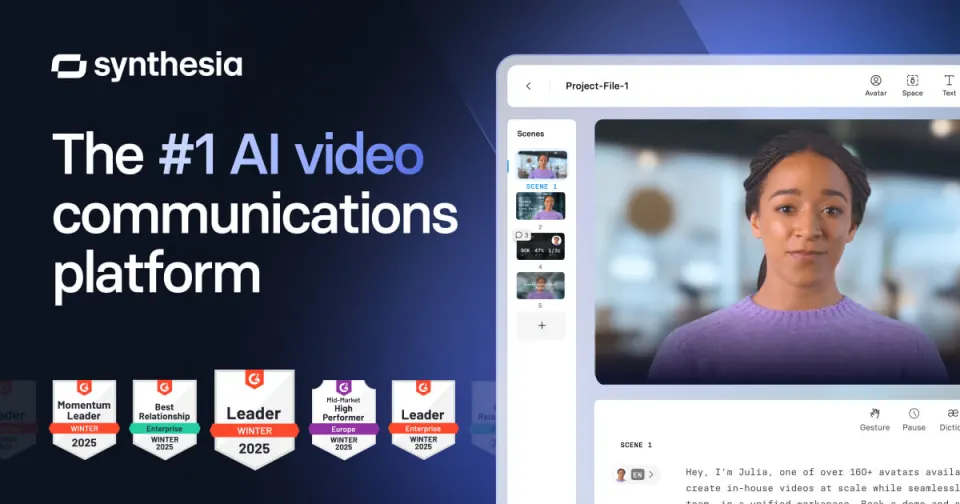
 SynthesiaBest structured business videoView tool details →
Synthesia is the stronger choice for structured videos that must be updated, governed, translated, and reused: product education, customer onboarding, sales enablement, partner training, internal launches, compliance, and software walkthroughs. Its scene-based editor behaves more like a presentation system than a film studio.
For instance, teams can combine scripts, AI avatars, screen recordings, templates, brand assets, collaboration, comments, and translations. Furthermore, higher plans add more avatars, personal avatars, interactive video, API access, workspaces, SSO, and delivery controls.
Where Synthesia is strongest
Repeatable structure. For example, a team can replace a scene or change a script without reshooting the entire program. Governance. Templates, workspaces, brand controls, and enterprise administration support controlled production. Localization. One structured master can become many language versions.
Where Synthesia falls short
However, the disciplined format is not ideal for emotional brand films, cinematic product scenes, or creator-style spontaneity. Presenter delivery can feel formal, so scripts should use short sentences, purposeful visuals, natural pacing, and human-reviewed pronunciation.
Synthesia Basic is free. Starter costs $29 per month for up to ten minutes of video or dubbing, while Creator costs $89 with more credits and features. Choose Synthesia if: your marketing organization treats education and enablement video as a repeatable program.
14. ElevenLabs: AI marketing tool for voiceovers and dubbing

 ElevenLabsBest voiceovers and multilingual dubbingView tool details →
ElevenLabs is the best audio specialist in this list. A marketing team can produce voiceovers, clone approved voices, design synthetic voices, dub video, translate audio, generate sound effects and music, organize longer projects in Studio, or integrate speech into products and automated workflows.
Its current dubbing documentation supports more than 90 languages and aims to preserve timing, tone, emotion, and speaker identity while retaining background audio. That makes it valuable for product videos, podcasts, ads, social clips, accessibility, and regional campaigns.
Where ElevenLabs is strongest
Natural voice quality. Strong speech models and controllable voices can outperform generic text-to-speech. Localization. Dubbing can adapt existing assets without rebuilding the entire soundtrack. Audio breadth. Voice, music, effects, isolation, transcription, and production share one credit pool.
Where ElevenLabs falls short
Even so, shared credits make cost forecasting harder because different products consume them at different rates. Voice cloning also creates serious consent and fraud risk. Use written permission, approved scripts, role-based access, disclosure where appropriate, and native-language review. Never clone a customer, employee, creator, or public figure without explicit authorization.
The free plan includes 10,000 monthly credits. Starter costs $6 per month and adds a commercial license and dubbing; Creator costs $22 monthly before any temporary first-month discount. Choose ElevenLabs if: voice quality or multilingual audio is a core campaign deliverable.
15. Zapier: AI marketing tool for marketing automation

 ZapierBest marketing automation and orchestrationView tool details →
Zapier is the best tool for turning separate marketing applications into a functioning system. It can collect a lead from a form, enrich or classify it, update the CRM, create a personalized draft, alert the correct owner, add the record to a campaign, store structured data, and log the result—without a marketer copying fields between tabs.
Zapier now combines workflows, Tables, Forms, Copilot, AI fields, agents, chatbots, webhooks, and an action layer for AI clients. The important value is orchestration: the model can reason or transform information, while Zapier moves approved data and actions through the stack.
Where Zapier is strongest
Connectivity. A large integration ecosystem covers the tools marketers already use. Low-code execution. Teams can build useful systems without waiting for a custom application. Structured AI steps. Classification, extraction, summarization, drafting, and tool calls can sit inside deterministic workflow rules.
Where Zapier falls short
That said, automation can multiply mistakes. A malformed field, duplicate trigger, weak prompt, or missing approval can send bad data to thousands of records. Task-based pricing also grows with volume and multi-step workflows; advanced AI models use higher task multipliers. Add test records, filters, human approval, alerts, rate limits, and a documented rollback.
The Free plan includes 100 tasks per month and simple workflows. Professional starts at $19.99 per month with annual billing; Team starts at $69. Choose Zapier if: the bottleneck is handoff between tools rather than content generation itself.
Which AI marketing tool should you choose?
For a solo marketer or very small team
Start with ChatGPT for thinking and production, Canva for visual execution, and Buffer for social publishing. Add Grammarly if final editing consumes time. This stack covers the widest range of jobs before a specialist becomes necessary.
For a brand or content team publishing at scale
Choose Jasper when brand governance and multi-user production are the priority. For content planning, choose Frase when the content library needs planning, publishing, audits, and decay monitoring. Choose Writesonic when AI-search visibility is a measurable strategic channel, or Surfer when writers need focused on-page guidance.
For lifecycle and revenue marketing
Choose HubSpot Breeze when campaigns should use CRM context and connect to contacts, sales, service, and attribution. Choose Copy.ai when the team wants to codify complex go-to-market workflows across systems. Use Zapier to connect applications and enforce the handoffs.
For visual and multimedia campaigns
Choose Canva for fast social and campaign variants. Instead, choose Adobe Firefly when professional designers must continue into a precise production workflow. Choose HeyGen for external presenter and localization work, Synthesia for structured education, and ElevenLabs for premium voiceovers and dubbing.
Do not buy 15 tools: build a three-layer marketing stack
Most teams need three layers, not 15 subscriptions:
- A thinking and production layer. ChatGPT for flexibility or Jasper for governed brand production.
- A channel specialist. Choose the tool that owns your most valuable output: HubSpot for lifecycle, Writesonic or Frase for discovery, Canva or Firefly for design, HeyGen for localized video, or ElevenLabs for audio.
- An orchestration and measurement layer. Zapier for cross-tool automation, or the native workflows and analytics in HubSpot when the CRM is the center of the stack.
Add a new tool only when you can name the bottleneck, owner, expected output, source data, review step, and success metric. If two tools solve the same job, run a short pilot with your hardest real brief and keep the one that produces the most publishable work—not the most impressive demo.
Practical rules for responsible AI marketing
- Ground every claim. Connect outputs to approved product facts and source evidence; never publish invented research, testimonials, prices, or performance claims.
- Protect customer data. Do not upload personally identifiable information, confidential interviews, unreleased strategy, or regulated data until retention, training, access, and enterprise terms are approved.
- Keep human approval at consequential steps. Require review before a campaign publishes, a lead is rejected, a price is shown, a public reply is sent, or a large database changes.
- Respect likeness and voice. Obtain explicit permission for avatars, clones, customer stories, and synthetic presenters; document the allowed uses and expiration.
- Review localization culturally. A fluent human should check tone, idiom, claims, pronunciation, imagery, and legal requirements in every target market.
- Measure outcomes, not output volume. Track qualified pipeline, conversion, retention, search visibility, engagement quality, time saved, and error rate—not the number of assets generated.
- Preserve brand taste. AI should expand options and reduce mechanical work. The final choice still needs human judgment, differentiation, and a reason for the audience to care.
Our final recommendation: begin with ChatGPT if you want the best all-round marketing workspace. Move to Jasper when consistent brand production becomes the limiting factor, HubSpot Breeze when CRM context and lifecycle automation matter most, Canva for high-velocity visual content, Writesonic for combined SEO and AI visibility, and Zapier when disconnected tools and manual handoffs slow the team down.
Frequently asked questions
What is the best AI marketing tool overall?
ChatGPT is the best overall option for most teams because it can support research, strategy, messaging, analysis, copy, images, and reusable workflows in one flexible workspace. Jasper is better for formal brand governance and scaled campaign production, while HubSpot is better when AI must work directly with CRM and lifecycle data.
What is the best free AI tool for marketing?
ChatGPT is the most useful general free starting point. Canva Free is stronger for visual assets, Buffer Free supports basic social scheduling, Grammarly Free improves final writing, and HubSpot provides free CRM and marketing tools. Free plans have meaningful limits, so test the complete workflow before choosing a paid tier.
Which AI tool is best for content marketing and SEO?
Writesonic is our best combined choice for SEO, content production, and AI-search visibility. Frase is stronger for an ongoing content operations loop that includes publishing, audits, and decay monitoring. Surfer is best for hands-on optimization of specific pages. A general assistant remains useful for research and original synthesis, but it should not invent sources or replace expert editing.
Which AI tool is best for social media marketing?
Canva AI is best for creating and adapting social visuals, while Buffer is best for planning, repurposing, scheduling, and reviewing performance. Many small teams should use both: Canva for the asset and Buffer for the calendar. Keep channel-specific hooks and community responses human rather than auto-publishing the same generic copy everywhere.
Which is better for marketing, Jasper or ChatGPT?
ChatGPT is better for flexible research, analysis, strategy, ideation, and multimodal work at a lower individual price. Jasper is better for a multi-user marketing organization that needs structured brand voices, audiences, approved knowledge, marketing agents, permissions, and consistent execution across many assets.
Can AI automate an entire marketing department?
No. AI can accelerate research, drafts, adaptations, analysis, routing, and repetitive production, but marketing still requires customer understanding, positioning, creative judgment, channel expertise, relationships, legal review, data governance, and accountability. Automate bounded tasks and handoffs, not responsibility.
How many AI marketing tools should a small business buy?
Usually two or three. Start with one general thinking and production tool, one specialist for the most valuable channel, and one automation or CRM layer only when manual handoffs justify it. Additional subscriptions should have a named owner, a measurable bottleneck, and a clear replacement or integration plan.
Is AI-generated marketing content safe to publish?
Only after review. Verify facts, claims, customer data, prices, links, citations, licenses, trademarks, consent, accessibility, cultural meaning, and disclosure requirements. Keep records of sources, approvals, prompts, models, and media rights for important campaigns.